
Die geometry, the angles and lengths inside the die bore, controls how the wire deforms, how smooth its surface is, how accurate its size is, and how long the die lasts. Two dies made of the exact same material can perform completely differently if their geometry is wrong for the wire. Geometry is not a finishing detail. It is the difference between good wire and scrap, and between a die that lasts and one that fails early.
Why Die Geometry Matters More Than You Think for Wire Quality
When buyers compare wire drawing dies, the conversation almost always starts with material. Carbide or PCD? Natural diamond or diamond-coated? It is an important question, but it is not the whole question, and treating it as the whole question is one of the most common and costly mistakes in wire drawing.
Material sets the potential of a die. Geometry decides whether that potential is realised. You can buy the hardest, most expensive diamond die in the world, but if its internal angles are wrong for your wire, it will produce poor wire and wear out faster than it should. The material is the raw capability. The geometry is the engineering that turns a hard block into a precision tool.
In our decades of making dies, we have seen this play out again and again: the same material, two different geometries, two completely different results. Here is why the shape inside the bore matters so much more than most people think.
Geometry decides how the wire deforms
When wire passes through the reduction zone, it is being reshaped under enormous pressure. It is not simply squeezed; the metal flows, and the angle of the reduction zone controls how it flows.
When the angle and the reduction are well matched, the metal deforms evenly from the surface all the way to the core. The wire comes out uniform, strong, and consistent. When they are mismatched, the deformation becomes uneven. The surface and the centre of the wire are worked by different amounts, leaving internal stresses you cannot see from the outside.
In the worst cases, the wrong combination, a large die angle paired with a small reduction, can actually pull the centre of the wire apart, creating internal cracks known as centre bursts or chevron cracks. These defects are invisible on the surface. The wire can look perfect and still be compromised internally, only to fail later in the customer's process. Few quality problems are more damaging than the ones you cannot see, and many of them trace straight back to geometry
The right geometry keeps deformation uniform and controlled. That uniformity is the foundation of wire that performs reliably, every time.
Geometry controls surface finish and accuracy
The bearing, the straight section that sizes the wire, is where final diameter and surface quality are set. And the bearing only works correctly when its length and the reduction angle that feeds into it are correct for the wire.
When the geometry is right, the wire comes out smooth, on size, and consistent from the first metre to the last. When it is wrong, you get poor surface finish, dimensional drift, or both. The bearing might be too short to hold size reliably, or the reduction zone might be feeding the wire in unevenly.
This matters in every application, but it becomes critical in the most demanding ones:
-
Jewellery wire that needs a flawless, mirror-bright finish.
-
Medical wire, where a few microns of deviation can mean rejection.
-
Electronics and fine wire, where surface quality directly affects electrical performance.
In these jobs, geometry is not a nice-to-have. It is the entire difference between a part that ships and a part that is scrapped.
Geometry decides how long your die lasts
Geometry directly determines how long the die will keep making good wire. Here is the part many buyers never consider: the mechanism is precise. As wire enters the reduction zone, it should make first contact between one-third and two-thirds of the way up the cone. When it does, the load is spread across the working surface and wear progresses slowly and evenly.
But when the reduction angle is too wide for the wire's elongation, the contact point shifts too close to the bearing. A wear ring forms quickly at that point. From there, the wear creeps steadily toward the bearing. Once it arrives, the wire goes oversized, the surface finish drops, and the die is effectively finished, sometimes after a fraction of the life it should have delivered.
In other words, two identical diamond dies can have completely different lifespans purely because of their geometry. One spreads the load and lasts for years of production. The other concentrates the wear and burns out early. This is also why poor geometry is so expensive; it does not just cost you in quality, it quietly raises your cost per tonne by shortening the working life of every die.
The rules of good geometry
Decades of experience on the drawing floor have produced clear, dependable principles:
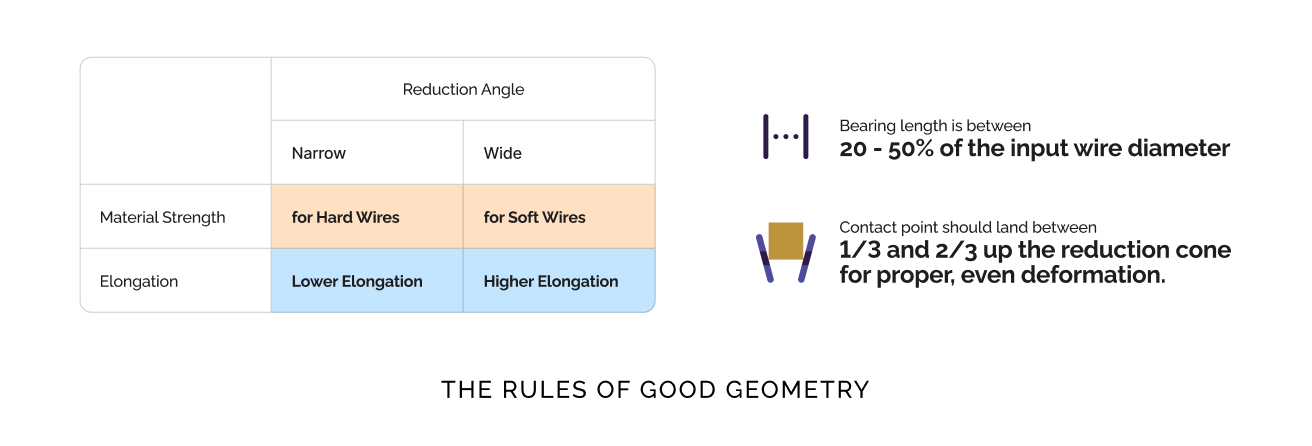
Reduction angle and material:
Harder wire needs a narrower reduction angle; softer wire suits a wider one.
Reduction angle and elongation:
Higher reduction or elongation calls for a wider angle; lower elongation needs a narrower one.
Bearing length:
Typically 20 to 50 percent of the wire diameter, tuned to the material and process.
Contact point:
Should land between one-third and two-thirds up the reduction cone.
These are reliable starting points, not universal settings. The exact figures depend on your specific wire, your reduction schedule, your lubricant, and your machine speed. Geometry is a system of trade-offs, and the right balance is the one calculated for your conditions.
Why generic dies fall short
This is the crux of it. A die bought from a generic specification treats every wire the same. But your wire is not generic. Copper behaves nothing like steel. Fine wire has different needs than heavy gauge. A slow line and a high-speed line place very different demands on the same geometry.
A die designed for "average" conditions is, by definition, wrong for your specific conditions. It may be close enough to function, but "close enough" shows up as inconsistent quality, occasional defects, and dies that wear out sooner than they should. Over a year of production, those small gaps add up to real money.
When people complain that a die "just does not perform like it should," the cause is far more often geometry than material. The block was hard enough. The shape inside it was simply wrong for the job.
The Walson Woodburn approach
We design die geometry around your wire, not around a catalogue. We factor in your material, your reduction, your lubrication, and your machine type, and we engineer the angles and bearing to suit. The result is wire that meets specification consistently and dies that last longer, two outcomes that together lower your true cost of production.
Material gives a die its potential. Geometry is how that potential becomes performance. Get the geometry right, and quality, consistency, and die life all follow.
Want dies engineered for your wire and your process? Speak to our team and we will get the geometry right, the first time.
New Articles
The Latest we have to offer

Anatomy of Die
Written on 12 May 2026

Maintenance
Written on 13 July 2026

18 August 2026
×
![product]()
* COMPULSORY
DOWNLOAD FORM - TECHNICAL HANDBOOK
✅ Thank you! Download link sent to your email.