
Watch for five signs that a drawing die needs attention: rising drawing force, wire coming out oversized, declining surface quality, more frequent wire breaks, and visible wear or a wear ring in the bore. Catch these early and the die can usually be reconditioned for a fraction of the cost of a new one. Catch them late and you are paying for a replacement plus all the scrap and downtime in between.
Five Signs It's Time to Recondition (or Replace) Your Drawing Dies
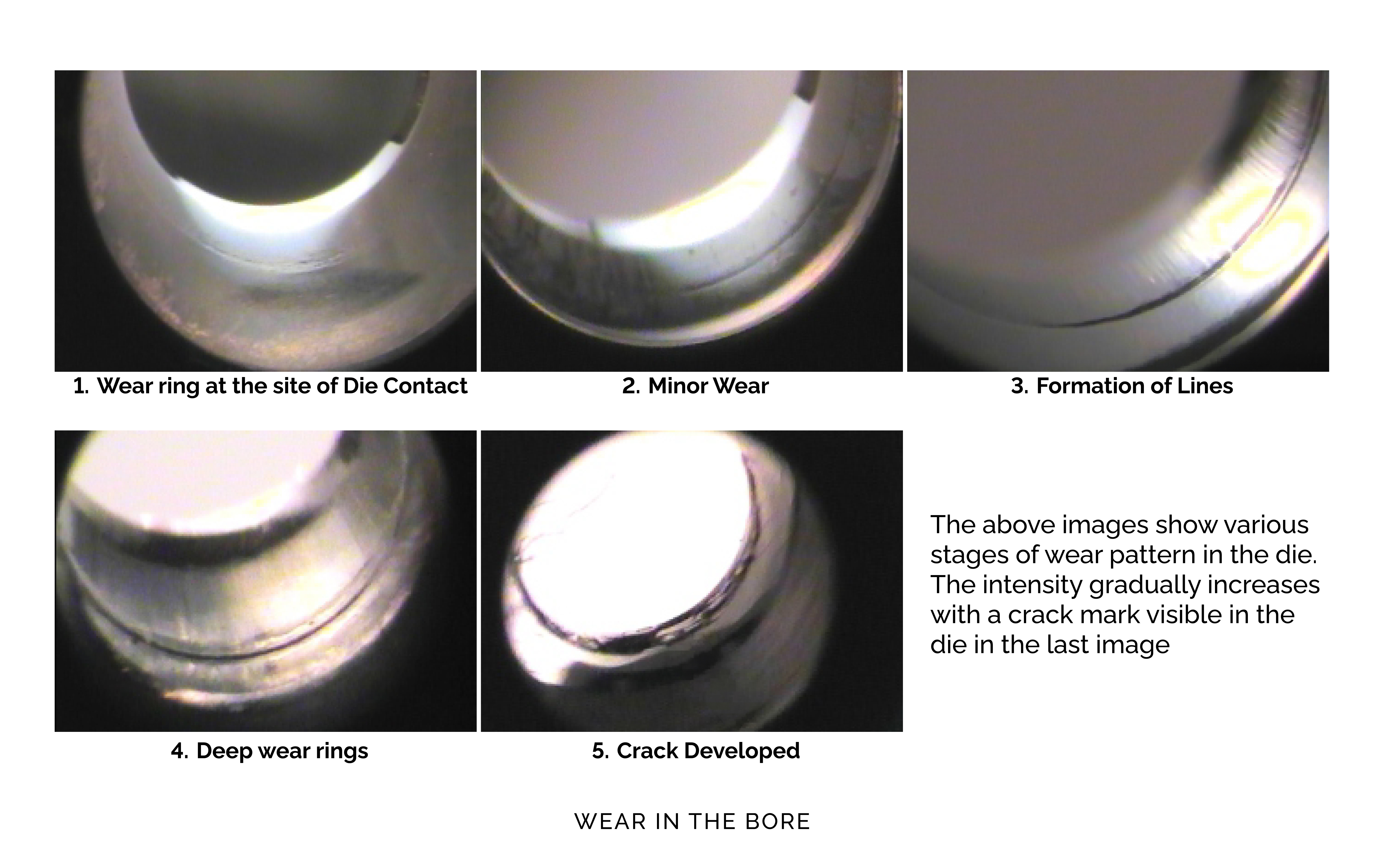
A wire drawing die almost never fails all at once. It does not snap or seize without warning. Instead, it wears gradually, and as it wears it sends a series of clear signals, if you know how to read them.
This is one of the most valuable skills on any drawing floor, because the difference between catching a die early and catching it late is the difference between a cheap repolish and an expensive replacement, with a trail of scrap and stoppages along the way. The wear itself is unavoidable. Letting it take you by surprise is not.
Here are the five signs we tell every customer to watch for, what each one means, and what to do about it.
1. Drawing force is climbing
What you'll notice: The force needed to pull the wire through the die is steadily rising compared to normal. This is often the very first warning, and the most useful, because it shows up before the wire itself goes out of spec. When drawing force climbs, something inside the die has changed. The usual culprits are wear that has roughened the bore, metal build-up (clogging) that has narrowed the clearance, or a degraded surface finish inside the die. Whatever the cause, higher force means more energy consumed, more heat generated, and a higher risk of breaks.
What to do: Measure drawing force regularly and know your baseline for each die and product. A steady, progressive rise is your earliest signal to pull the die and inspect it, well before it starts producing bad wire. Treat rising force as the smoke detector of the drawing floor.
2. The wire is coming out oversized
What you'll notice: Finished wire is measuring above specification, even slightly. The bearing, the straight section of the die, is what sets your final diameter. As it wears, the bore enlarges and the wire drifts above target. The change is often gradual, a micron here, a micron there, which is exactly why it is dangerous: oversized wire can look perfectly fine and still fail quality checks downstream, or cause problems in your customer's process.
What to do: Track wire diameter with regular, consistent measurement. The moment size starts creeping upward, the bearing is wearing and the die needs attention. Reliable measurement, with good instruments and a routine, is what turns this from a costly surprise into an early, manageable signal.
3. Surface quality is getting worse
What you'll notice: Scratches, dull patches, or a generally rougher finish on the wire. Surface defects usually mean the bore is no longer smooth. This happens when wear reaches the bearing, when build-up forms inside the die, or when the polished working surface has broken down. In finish-critical work, jewellery, medical, electronics, even a small drop in surface quality is enough to render the wire unusable.
What to do: Inspect the wire surface as part of your routine, not just when there is a complaint. A decline in finish is a clear sign the die needs polishing now, while the damage is still shallow. Acting at this stage often means a simple repolish; waiting can mean the surface damage has reached the bearing, narrowing your options.
4. Wire breaks are becoming more frequent
What you'll notice: A line that used to run clean is now breaking wire more often. A rising break rate frequently points straight back to the die. Wear, clogging, overheating from friction, and geometry that has worn out of shape all raise the stress on the wire and make breaks more likely. And every break is expensive twice over, lost production time while you re-thread and restart, and lost material in the scrap bin.
What to do: If breaks are increasing on a previously stable line, put the die near the top of your suspect list. Inspect it as part of troubleshooting before assuming the problem lies elsewhere. Frequent breaks are rarely random; they are usually telling you something specific about the tool.
5. You can see wear in the bore
What you'll notice: Under inspection, a visible wear ring or groove inside the die. This is the most direct sign of all, and reading it correctly is what determines your next move. Wear almost always begins as a ring at the wire's contact point in the reduction zone. In the early stage, that ring is shallow and the bearing is still in good condition, which is precisely the moment when reconditioning is easiest and most complete. Left longer, the wear spreads from the ring toward the bearing, and once it reaches the bearing your options narrow sharply.
What to do: Inspect the bore on a schedule rather than waiting for the wire to tell you something is wrong. The depth and location of the wear, ring still confined to the reduction zone, or wear that has reached the bearing, tells you whether the die can be simply repolished or needs resizing.
Recondition or replace? How to decide
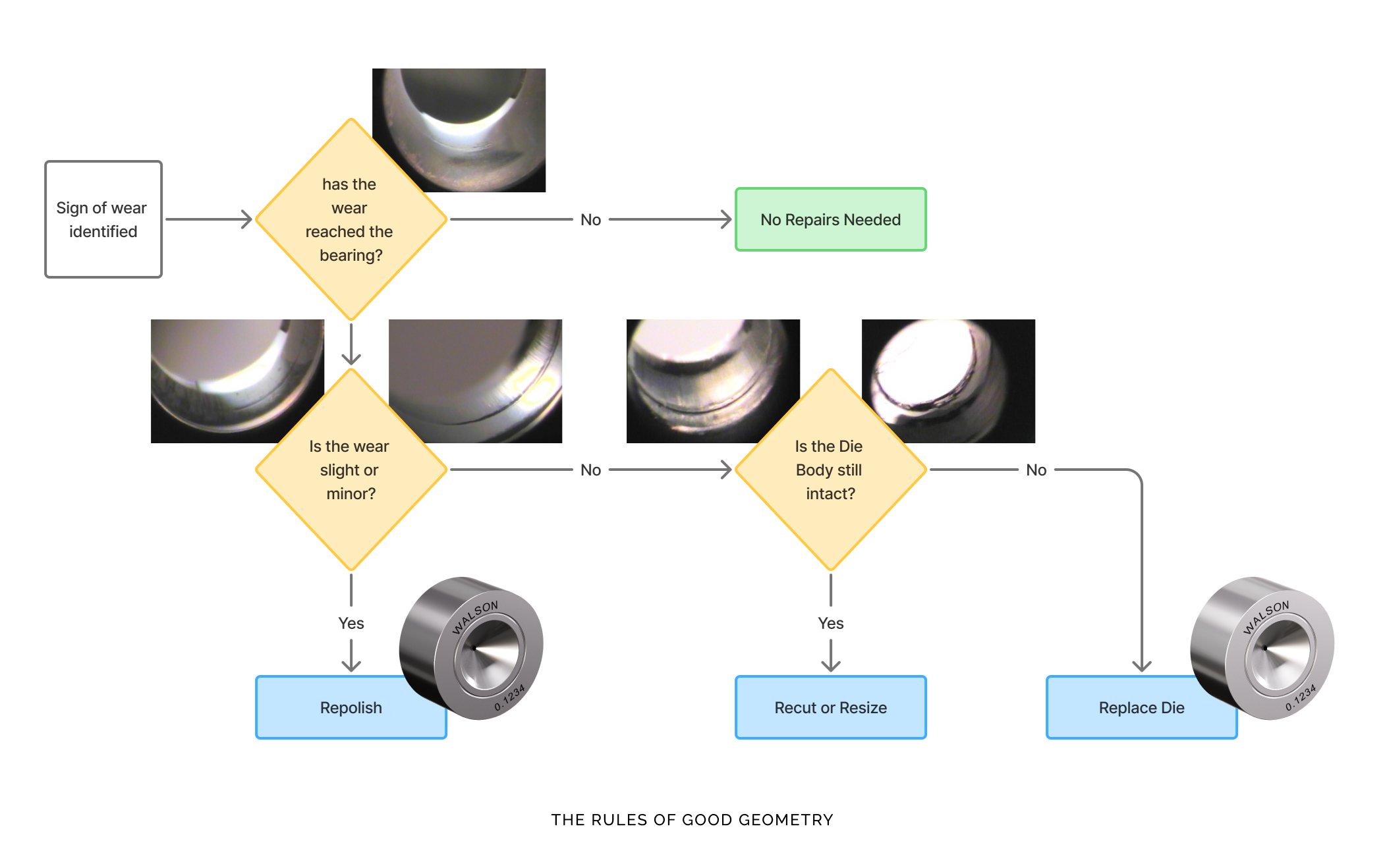
Once you spot the signs, the decision depends on whether the wear has reached the bearing.
Repolishing:
It is the best and most economical option, and it is possible when the wear is still slight and the bearing is undamaged. It removes the defects from the reduction angle and restores the die to working condition.
Resizing or Recutting:
It enlarges the bore to the next size. This is the route when repolishing alone is not enough, but the die body is still sound. The die simply moves to a larger position in your drawing schedule and keeps earning
Replacement:
Necessary only when the die can no longer be restored to a usable size.
The pattern is clear: the earlier you act, the more likely you keep the die in service through low-cost reconditioning, and the less you spend overall. Almost every expensive die replacement began as an early warning sign that was missed or ignored.
Build inspection into your routine
The encouraging truth is that nearly all die wear is predictable and most of it is catchable. The factories that spend the least on tooling are not the ones that buy the cheapest dies, they are the ones that catch wear early through simple, consistent habits:
-
Measure drawing force: Know the baseline for each die and product; a steady rise is your earliest signal that the die needs inspection.
-
Check wire diameter: Monitor size regularly and consistently to catch wear before the wire drifts out of specification.
-
Monitor surface finish: Inspect the wire surface as part of your routine to detect defects like scratches or dull patches while damage is still shallow.
-
Watch break rates: If a previously stable line begins breaking wire more often, include the die in your troubleshooting investigation.
-
Schedule bore inspection: Inspect the bore on a set schedule rather than waiting for wire quality to decline, allowing you to determine if a simple repolish is sufficient.
A routine like this costs very little and pays for itself many times over, by turning sudden, expensive failures into early, inexpensive reconditioning.
The Walson Woodburn approach
We offer die polishing and reconditioning services backed by proactive maintenance and inventory management. The aim is straightforward: keep your lines running, reduce downtime, and stretch every die as far as it will safely go before it is finally retired. The signs above are how you know when to act, and we are here to handle what comes next.
Not sure whether your dies need attention? Talk to our team about reconditioning and inventory support, and we will help you get the most from every die you own.
New Articles
The Latest we have to offer

Anatomy of Die
Written on 12 May 2026
Die Engineering
Written on 13 June 2026

18 August 2026